Show Me the Money
EAP ROI Calculator: How Much Are You Wasting?
Most HR teams can't quantify the impact of their EAP. Here's how to calculate what your program should be returning — and what it probably isn't.

Return on investment is the metric that separates employee benefits that survive budget cuts from those that get axed. Yet most EAP providers are maddeningly vague about their ROI, hiding behind generalizations like "studies show a positive return" without giving you the tools to calculate what that means for your specific organization. Let's fix that.
Understanding EAP ROI Metrics
EAP ROI is typically measured by comparing the cost of the program against the financial value created through improvements in four key areas:
Reduced Absenteeism
Employees with untreated mental health conditions miss an average of 4-5 extra days per year. Effective EAPs reduce this significantly, recovering productivity worth $1,500-3,000 per affected employee annually.
Lower Turnover
Replacing an employee costs 50-200% of their annual salary. Mental health support reduces voluntary turnover by 20-40% among at-risk employees. For a company with 1,000 employees and 15% annual turnover, even a modest reduction saves hundreds of thousands.
Decreased Presenteeism
Presenteeism — showing up to work but performing below capacity — costs employers 2-3x more than absenteeism. Employees dealing with depression lose an estimated 27 productive days per year to presenteeism.
Fewer Disability Claims
Mental health conditions are among the fastest-growing categories of short and long-term disability claims. Early intervention through EAPs can prevent conditions from escalating to the point where employees need disability leave.
Industry ROI Benchmarks
Let's look at what different types of EAP providers deliver in terms of documented ROI:
| Provider Type | Typical ROI | Key Drivers |
|---|---|---|
| Traditional EAP | 1-2x | Low utilization limits impact; basic services |
| Industry Average | 2-3x | Mixed utilization; moderate clinical outcomes |
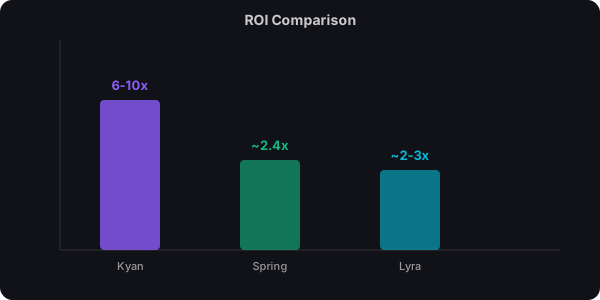
| Spring Health | ~2.4x (3yr) | Precision matching; strong clinical focus |
| Lyra Health | ~2-3x | Evidence-based care; 83% recovery rate |
| Kyan Health | 6-10x | 10x utilization; full care spectrum; AI engagement |
The gap between Kyan's 6-10x ROI and the competition's 2-3x isn't just incremental — it's a fundamentally different value proposition. The primary driver of this difference is utilization. When 30% of employees use the platform versus 3-5%, the denominator in the ROI equation changes dramatically. More people getting help means more absenteeism prevented, more turnover avoided, and more presenteeism reduced.
The Cost of NOT Having an Effective EAP
Let's run the numbers for a hypothetical 1,000-employee company to illustrate what an underperforming EAP is costing you in hidden losses:
| Cost Category | Annual Impact | Calculation |
|---|---|---|
| Excess Absenteeism | $300,000-500,000 | 200 affected employees x 4 extra days x $375-625/day |
| Preventable Turnover | $750,000-1,500,000 | 15-30 preventable departures x $50-100K replacement cost |
| Presenteeism | $600,000-1,000,000 | 200 affected employees x 27 lost days x $110-185/day |
| Disability Claims | $200,000-400,000 | 5-10 preventable claims x $40,000 average cost |
| Total Hidden Cost | $1.85M-3.4M/year | Sum of above |
Even if a modern EAP addresses just 20-30% of these hidden costs, you're looking at $370K-1M in annual value — far exceeding the $72K annual cost of a mid-tier provider like Kyan Health for a 1,000-person company. That's where the 6-10x ROI comes from. It's not magic — it's math.
Example Scenarios by Company Size
SMALL (250 employees)
Traditional EAP cost: $6K/yr
Hidden losses: $460-850K/yr
Kyan cost: $18K/yr
Value created: $108-180K/yr
MID-SIZE (1,000 employees)
Traditional EAP cost: $24K/yr
Hidden losses: $1.85-3.4M/yr
Kyan cost: $72K/yr
Value created: $432-720K/yr
ENTERPRISE (5,000 employees)
Traditional EAP cost: $120K/yr
Hidden losses: $9.2-17M/yr
Kyan cost: $360K/yr
Value created: $2.16-3.6M/yr
Building the Business Case
Armed with these numbers, you can build a compelling business case for upgrading your EAP. The key points to emphasize with finance and leadership:
- Current EAP utilization is likely 3-5%, meaning you're paying for a benefit almost nobody uses
- The hidden costs of untreated mental health (turnover, absenteeism, presenteeism) dwarf the cost of a modern EAP
- Upgrading to a provider like Kyan at $4-8 PEPM delivers 6-10x ROI through dramatically higher engagement
- The incremental cost over a basic EAP is minimal compared to the value created
Need more ammunition? Our pricing guide breaks down the full cost picture, and our comparison page gives you the feature-by-feature data to back up the switch. When you're ready to move forward, our transition guide makes the process painless.
Stop wasting money on an EAP nobody uses
Kyan Health delivers 6-10x ROI with 10x utilization — the math speaks for itself.
Explore Kyan Health